Episode 27 — Rehearse the ITIL Value System Until the Moving Parts Click Together
In this episode, we slow the pace just enough to bring the whole model back into view and make it feel like one connected idea rather than a stack of separate lessons. When people first learn the Information Technology Infrastructure Library (I T I L) Value System, the individual pieces can make sense one at a time, yet the full picture can still feel slippery because each part seems to have its own vocabulary, its own purpose, and its own place in the larger story. That is a normal stage for a new learner, because service management only becomes comfortable after you hear how the moving parts influence one another again and again in realistic situations. The goal here is not to add a new layer of complexity. The goal is to rehearse what is already on the table until the interactions become familiar, the flow becomes easier to picture, and the whole system begins to feel like a natural way to think about how value is created, supported, and improved over time.
Before we continue, a quick note: this audio course is a companion to our course companion books. The first book is about the exam and provides detailed information on how to pass it best. The second book is a Kindle-only eBook that contains 1,000 flashcards that can be used on your mobile device or Kindle. Check them both out at Cyber Author dot me, in the Bare Metal Study Guides Series.
A good rehearsal starts by remembering what the value system is trying to do at the highest level. It is the overall model that explains how an organization responds to demand and opportunity and turns them into value for stakeholders through connected forms of work, direction, capability, and learning. That one sentence matters because it helps stop the common beginner mistake of treating the value system like a vocabulary list instead of a living model. Demand and opportunity enter from the outside world because people need something, want something improved, or recognize that a better outcome is possible. The organization responds inside a structure shaped by governance, guiding principles, the service value chain, practices, continual improvement, and the Four Dimensions. When those elements support one another, the organization is more likely to create value in a way that is useful, trusted, and sustainable. When those elements pull apart, the work may still continue, but it becomes easier for the service to grow confusing, fragmented, or less responsive to real needs.
Before any one part starts moving, demand and opportunity are what give the system a reason to act. Demand is the need or desire for products and services, while opportunity is the chance to create better value through improvement, innovation, redesign, or a smarter response to changing conditions. These are not decorative words at the entrance of the model. They are the real signals that start the motion. A community college might see demand when students struggle to register for classes online and flood support channels with questions. The same college might see opportunity when it realizes a redesigned student portal could make registration clearer, reduce confusion, and improve trust in the institution. One signal says people are already feeling pain in the present, while the other says a better future is possible if the organization acts wisely. Rehearsing the system well means hearing both clearly, because value creation usually begins when the organization notices what people need now and what could be improved next.
Once that signal enters the system, governance helps place direction around the response so the organization does not simply chase the loudest complaint or the most fashionable idea. Governance sets objectives, clarifies accountability, defines important boundaries, and helps ensure that work remains aligned with the purpose and responsibilities of the organization. A beginner can easily think governance sounds far away from daily service work, but the rehearsal becomes clearer when you picture governance as the part that says what matters most, what risks are acceptable, and how leadership will know whether the service is heading in the right direction. In the student portal example, governance might clarify what outcomes are expected for students, what privacy obligations must be respected, what budget or accessibility boundaries exist, and who has authority over major decisions. It does not need to choose every screen layout or solve every support question itself. Its role is to frame the work so the people doing the daily work are moving in a direction that the organization can stand behind.
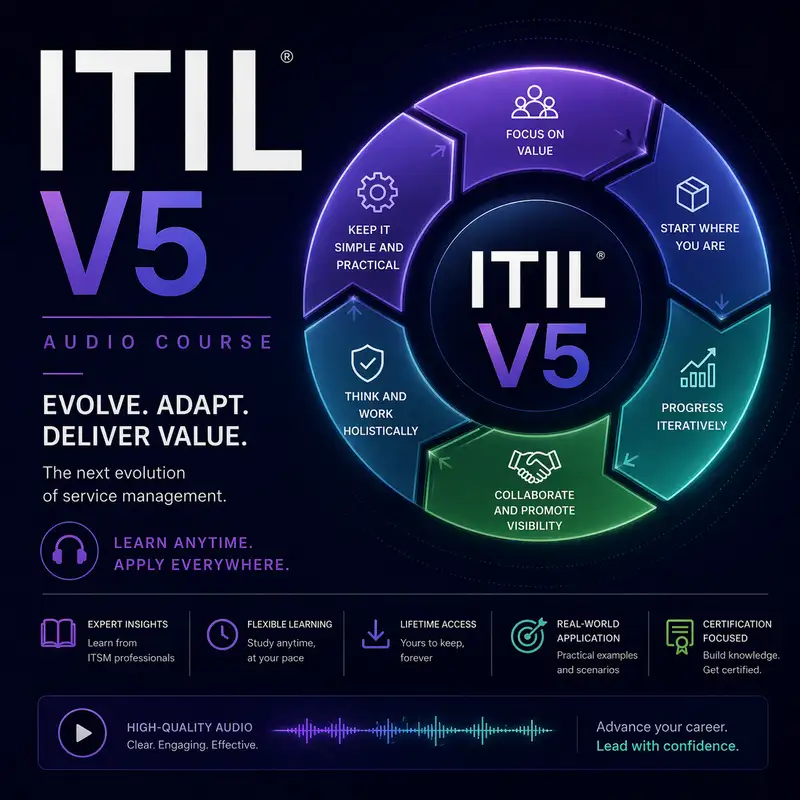
Inside that direction, the guiding principles influence how people think while the system is moving. They are not scripts and they are not detailed procedures. They are durable reminders that help people choose better responses when situations become uncertain, messy, or politically complicated. Focusing on value keeps attention on meaningful outcomes instead of internal busyness. Starting where you are encourages people to understand the present state before tearing it apart. Progressing iteratively with feedback helps the organization learn in manageable steps instead of gambling on giant change. Collaborating and promoting visibility reduce distortion and silence between groups. Thinking and working holistically keeps people from fixing one part while weakening another. Keeping it simple and practical protects the service from unnecessary weight, and optimizing and automating remind people to improve flow without abandoning judgment. Rehearsing the value system means hearing these principles not as slogans floating above the work, but as thinking tools that quietly shape how every part of the system responds to the signals it receives.
At the center of the motion is the Service Value Chain (S V C), which shows the major kinds of activity through which work moves as demand and opportunity are turned into value. Planning aligns intentions, priorities, resources, and current reality. Engaging keeps the organization connected to stakeholders so assumptions do not take over. Designing and transitioning shape solutions and move them into real use with care. Obtaining or building gives the organization the capabilities it needs to make the service real. Delivering and supporting keep the service functioning for people in daily life. Improving feeds learning back into the system so that value can grow stronger over time. The important thing to rehearse here is not a rigid line from left to right. The chain is a flexible operating model, which means different situations will move through it differently. A new service idea, a support issue, a supplier problem, or a redesign effort may all involve the same activities, but in different patterns and with different emphasis depending on what kind of need has entered the system.
Practices are what give the organization the real ability to perform that work instead of merely describing it in theory. A practice includes people, roles, knowledge, tools, procedures, and other resources that together form a usable capability. In a student portal story, service desk capabilities help when students are stuck and need support. Relationship management helps the college stay connected to the needs and expectations of students, faculty, and administrators. Change enablement helps adjustments move into the live environment responsibly. Incident management helps restore normal service when something breaks. Problem management helps the college learn from repeated issues instead of treating each one as a separate surprise. Rehearsing the system means remembering that practices are not detached from the value chain. They are the capabilities that allow the value chain to function in real life. Without practices, the value chain is a helpful picture with no working hands. With practices, the organization can actually engage, design, support, improve, and adapt in ways that people feel in the real service experience.
Continual improvement matters because no value system remains healthy by standing still. Needs change, users change, technology changes, partners change, and internal goals can change as well. A service that met the need well six months ago may now be awkward, confusing, or too slow for current expectations. Continual improvement keeps the system awake by asking what is working, what is not working, what is creating friction, and where stronger value could be created through sensible change. This part is easy to underestimate if you picture improvement as a special project that begins only after a major failure. In a well rehearsed value system, improvement is always present because learning is always present. Support interactions reveal where users struggle. Engagement reveals mismatched assumptions. Delivery reveals reliability gaps. New opportunities reveal where the service could become simpler or more useful. Improvement turns those observations into action, which is one reason it belongs inside the system rather than outside it.
The Four Dimensions help make the rehearsal more realistic by preventing the value system from being heard as a purely procedural model. Organizations and people remind you that services depend on roles, skills, ownership, communication, and culture, not just tasks on paper. Information and technology remind you that data quality, architecture, tools, and usability all shape what the service can actually deliver. Partners and suppliers remind you that outside relationships often influence the quality, speed, and resilience of the service, even when users never see those contributors directly. Value streams and processes remind you that work flows through paths, handoffs, rules, and feedback loops that either support value or delay it. Rehearsing the system until the moving parts click together means hearing these dimensions across the whole model. Governance decisions are affected by people and technology. Value chain activities depend on processes and suppliers. Practices rely on information, tools, and skills. Improvement becomes stronger when all four dimensions are examined rather than when the organization blames only the most visible surface issue.
Now picture the student portal as a full service story so the rehearsal becomes more concrete. Students are missing registration deadlines, receiving contradictory reminders from different offices, and contacting support because they cannot tell which steps matter most. Demand is clearly present because the current service experience is creating anxiety and confusion. Opportunity is present because the college can redesign the portal and the surrounding service experience so that students can move through registration with greater confidence and less repeated support. Governance provides direction by setting student success as a key outcome, defining accessibility and privacy expectations, and clarifying who can make major decisions about the redesign. The guiding principles influence how the college approaches the work, encouraging it to focus on value, start where it is instead of throwing away every existing system, collaborate across departments, and make manageable changes with feedback. The value chain provides the flow through planning, engagement, design, obtaining needed capabilities, delivery, support, and continued improvement. Practices give the college the ability to carry out that work in real life.
As the service moves from idea to action, the interactions among the parts become easier to hear. Engagement reveals that students do not just want a cleaner screen. They want fewer conflicting messages, clearer next steps, and stronger confirmation that tasks were completed successfully. Planning turns that insight into priorities, boundaries, and decisions about what outcomes matter first. Design and transition shape the actual experience and prepare the rollout so students and staff are not surprised by poorly explained change. Obtaining or building helps the college secure the needed platform changes, integrations, and communication capabilities. Delivering and supporting keep the live service available and understandable once the changes are introduced. Practices such as relationship management, service desk activity, change enablement, and incident handling make those activities workable. Continual improvement learns from what students still struggle with after launch and feeds that learning back into the system. Rehearsing the model in this kind of narrative helps you hear that none of the parts are competing. They are reinforcing one another inside a living service story.
A useful rehearsal also includes what happens when the system becomes unbalanced, because that is often where the value of the model becomes most visible. Suppose the college becomes excited about technology and buys a new portal platform quickly, but pays little attention to engagement, training, support readiness, or process clarity. The service may look modern, yet students may still feel lost because the messages are unclear and support teams are unprepared to explain the new experience. That is a failure of the system, not just a failure of the tool. Or imagine the college has strong governance and many careful approvals, but the decision rights are unclear and every change waits for too many committees. The service may become safe in a narrow sense while remaining frustratingly slow to improve. Or picture strong practices in separate teams with almost no collaboration or visibility between them. Work gets done, but the student experience still feels fragmented because each group optimizes its own piece without seeing the whole service. Rehearsal becomes powerful when you can hear not only how the system works well, but also how it weakens when one part dominates or one part disappears.
Another part of making the moving parts click together is understanding that the value system is dynamic rather than fixed. It is tempting to study it as a set of boxes and arrows that always hold still, but real services do not behave that way. A support incident can quickly trigger engagement, delivery, improvement, and later planning or design decisions. A new opportunity can begin in engagement with stakeholders, move into planning, require governance attention, depend on supplier decisions, and then return to improvement after release. Feedback from support may reshape practices, alter value chain activity, and influence strategic direction. That dynamic quality is why rehearsal matters so much for beginners. You are not just memorizing names. You are learning to hear a pattern of movement. Once that movement becomes familiar, the system stops feeling like a diagram that must be decoded and starts feeling like a language for understanding how organizations respond to needs, make decisions, coordinate work, and learn from experience.
A common beginner mistake is to think the value system exists mainly to make organizations more formal, more controlled, or more complicated. In reality, the system is trying to create clarity where complexity already exists. Services are already shaped by people, technology, suppliers, workflows, priorities, and feedback whether an organization admits it or not. The value system simply gives a more disciplined way to see those relationships and manage them with intention. Another mistake is to believe that value is created by one heroic team or one especially strong practice. A well rehearsed understanding shows that value is usually created when direction, thinking, capability, flow, and improvement all align well enough to support a useful experience for stakeholders. No single part deserves all the credit, and no single part can safely be ignored. That is why rehearsing the whole model matters more than simply memorizing the names of the pieces. You want to hear coordination, not just categories.
By the end of this rehearsal, the ITIL Value System should feel more like an integrated story and less like a set of disconnected study topics. Demand and opportunity provide the signal that something needs attention. Governance gives direction and accountability. Guiding principles shape judgment. The service value chain provides the flexible flow of activity. Practices provide the real capabilities that make that flow possible. Continual improvement keeps learning alive, and the Four Dimensions keep the whole model grounded in the realities of people, technology, suppliers, and working methods. When you hear those parts in motion through a realistic service situation, they begin to click together in a way that is much easier to remember and much easier to think with. That is the point of rehearsal. The model stops feeling like something outside you and starts becoming a natural lens for understanding how services create value, how they weaken, and how they can be strengthened with clearer, more connected thinking over time.