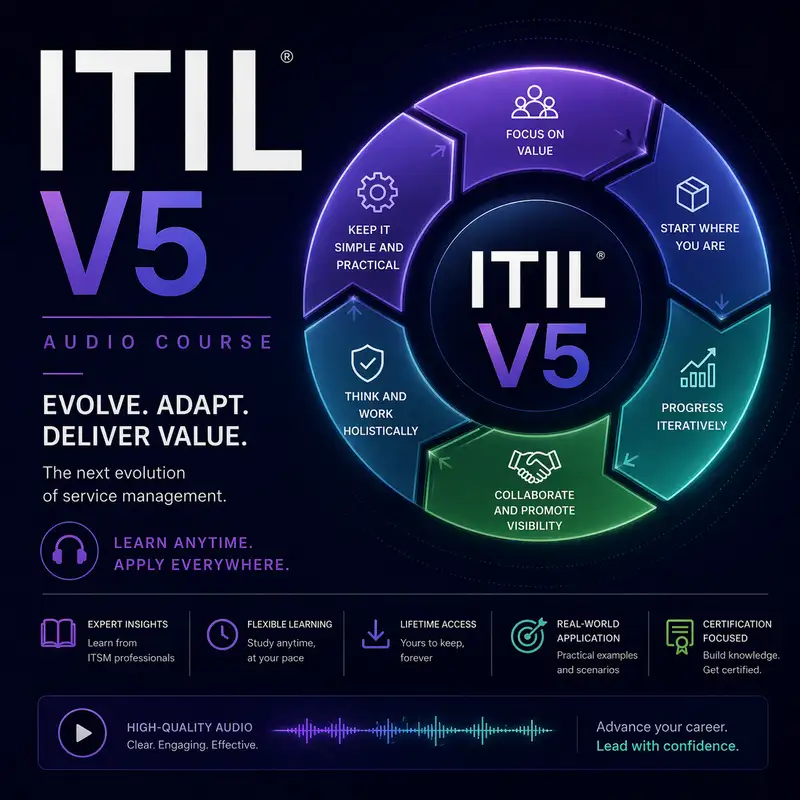
Episode 1 — Decode the ITIL Foundation Version 5 Exam Format and Build Your Audio-Only Study Plan
In this episode, we begin by taking the mystery out of the Information Technology Infrastructure Library (I T I L) Foundation Version 5 exam and turning it into something you can understand, plan for, and approach with calm. A lot of brand-new learners hear the words exam format and immediately think about trick questions, dense vocabulary, and a wall of ideas that all sound alike, but the better way to see this certification is as a guided test of understanding rather than a test of panic. The goal is not to make you feel like an expert on your first pass through the material. The goal is to help you recognize the key concepts, understand how they connect, and answer questions with steady judgment instead of guessing. That matters even more when your learning path is audio-only, because you are not leaning on slides, diagrams, or highlighted notes to rescue you. You are training your ear, your memory, and your ability to explain ideas clearly in your own mind. Once you understand what kind of exam this is really asking you to take, it becomes much easier to build a study plan that matches the challenge instead of fighting against it.
Before we continue, a quick note: this audio course is a companion to our course companion books. The first book is about the exam and provides detailed information on how to pass it best. The second book is a Kindle-only eBook that contains 1,000 flashcards that can be used on your mobile device or Kindle. Check them both out at Cyber Author dot me, in the Bare Metal Study Guides Series.
A foundation exam sits at the entry point of a subject, and that single word foundation tells you something important about the level of thinking expected. You are not being asked to design a full operating model for a global company, repair broken systems, or make advanced architectural choices under pressure. You are being asked to show that you understand the basic language, the central ideas, and the reason those ideas matter in modern service work. That means the exam rewards clarity more than cleverness. It favors learners who can recognize what a concept means, how it differs from nearby concepts, and why it shows up in real work, even if they have never held a formal service management role before. A beginner sometimes assumes a certification exam must be full of hidden complexity, but foundation-level learning usually works the other way around. It starts by making sure you can separate the essential from the optional. When you keep that in mind, the exam becomes less like a maze and more like a map that asks whether you can find the major landmarks without getting lost in side roads.
When people hear exam format, they often think only about mechanics such as how many questions there are, how long they will have, or whether the questions are multiple choice. Those mechanics matter, but they are only the surface of format. The deeper format of any certification exam is the pattern of thinking it expects from you. In a course like this, the questions are likely to reward accurate recognition, careful comparison, and the ability to connect a term to its purpose instead of just repeating a memorized phrase. A learner who knows a definition by sound alone may still struggle if the exam asks which idea best fits a situation, or which choice aligns most closely with the intended meaning of a concept. That is why understanding the format also means understanding the style of reasoning you are preparing for. You are training yourself to listen for meaning, not just vocabulary. You are learning to notice when two answer choices both sound plausible, but only one matches the central idea being tested. That type of judgment can absolutely be developed through audio, but it has to be practiced deliberately.
One of the smartest things you can do early is stop seeing the exam as a giant pile of separate facts. A strong beginner eventually realizes that the material is built in clusters, and each cluster carries a small family of related ideas. When your mind hears a concept, it should slowly begin to place that concept inside a larger neighborhood. You want to know whether it belongs to the language of value, the language of roles, the language of improvement, the language of flow, or the language of structure. That does not mean you need a visual chart in front of you. It means you need a mental sense that the course is organized around relationships, not random trivia. Once you hear the same ideas returning from different angles, the exam stops sounding like a long list of strange terms and starts sounding like one ongoing conversation about how services create value with people, practices, technology, and decisions working together. That shift matters because it changes the way you study. Instead of memorizing isolated words, you begin building a mental network, and that network is what helps you answer unfamiliar questions with confidence.
A foundation exam also tends to ask questions in recurring patterns, and knowing those patterns makes the experience feel more predictable. Some questions simply test whether you know what a concept means in plain language. Other questions test whether you can tell the difference between two similar ideas that beginners often blend together. Some questions may describe a short situation and ask which idea best explains what is happening, while others may ask which choice most closely supports the purpose of a practice or principle. None of that requires advanced technical skill, but it does require disciplined listening and careful reading on exam day. A beginner often gets trapped not because the topic is impossible, but because the wording of the choices feels familiar in a vague way. That vague familiarity is dangerous. Real preparation means learning the concepts well enough that you can hear the difference between almost right and actually right. Audio-first study can help with this because repeated listening trains the ear to notice distinctions in language. Over time, the key terms stop blending together, and the wording begins to sound more precise and meaningful.
One of the biggest misconceptions about this kind of exam is that memorizing a glossary is enough. Memorization does matter, because you cannot reason with terms you do not recognize, but memory without understanding is fragile. The moment a question changes the wording, adds a short scenario, or asks you to choose the best fit rather than the exact definition, shallow memorization starts to crack. The opposite misconception is just as risky. Some beginners assume that if they understand business or technology in a general way, they can rely on common sense and skip the formal language of the framework. That also creates problems because the exam is testing a specific body of meaning, not whatever sounds reasonable in everyday conversation. Good preparation sits between those two extremes. You want the vocabulary to be familiar enough that it comes to mind quickly, and you want the meaning to be deep enough that you can explain the concept in simple words without reciting a script. That is where audio learning becomes powerful. If you can hear an idea, restate it naturally, and recognize it in slightly different wording, you are moving from memory into usable understanding.
An audio-only study plan works best when you stop thinking of listening as passive exposure and start treating it as an active training method. When the material is explained clearly, your ear can become a strong tool for pattern recognition, especially if you listen more than once with different purposes each time. On one pass, you may simply be getting familiar with the language and the rhythm of the subject. On a later pass, you may be listening for contrast, asking yourself why one concept is not the same as another. On another pass, you may be testing whether you can predict the explanation before it finishes. This matters because memory grows stronger when the brain retrieves meaning instead of only receiving sound. The strength of audio is that it unfolds in time, and that helps you absorb sequence, cause and effect, and the way one idea leads to the next. If you respect that strength, audio-only study does not feel like a compromise. It becomes a focused way to build durable understanding, especially for learners who are willing to engage with what they hear instead of letting it drift past them.
A strong study plan begins with orientation, and orientation simply means learning what you are trying to master before you worry about mastering all of it. Your first goal is not perfection. Your first goal is familiarity. During your early study sessions, you want to hear the major concepts enough times that nothing sounds completely foreign by the end of the week. That first stage is where many anxious learners make a mistake. They hear a term they do not fully understand and immediately assume they are falling behind, but early confusion is normal because the mind is still sorting new language into useful categories. What helps is repeated exposure with purpose. After listening to a lesson, pause and say the idea back to yourself in everyday language, even if your explanation is rough at first. That act of restating is one of the most powerful things an audio learner can do because it reveals whether the concept is actually making sense. If you can explain a term simply, even imperfectly, you are already building the kind of understanding the exam will reward later.
Once the material starts to feel familiar, your plan should shift from exposure into rhythm. Long, heroic study sessions often feel productive in the moment, but short, repeated contact with the material usually works better for foundation learning because it keeps the concepts active in memory. Audio is especially good for this because you can return to it regularly without needing a desk, a screen, or a perfect block of quiet time. The important thing is not endless replay. The important thing is intentional replay. A useful rhythm might include one focused listening session where you pay close attention, followed later by a shorter replay where you check what still feels uncertain, and then a quiet moment where you try to explain the core idea without hearing it again. That pattern turns listening into recall practice, and recall practice is what makes knowledge available under exam pressure. The exam will not reward the version of learning where a concept feels vaguely familiar only while someone else is explaining it. It rewards the version that you can bring back on your own, with enough clarity to choose between competing answers.
As your study rhythm improves, another important shift happens. You stop asking whether you have heard a term before, and you start asking what job that term is doing in the larger system. That question is far more useful. A foundation learner grows faster when each idea is connected to a purpose. If a concept exists to describe value, then you should hear it as part of a conversation about outcomes and usefulness. If a concept exists to describe structure, you should hear it as part of a conversation about coordination and consistency. If a concept exists to describe improvement, you should hear it as part of a conversation about learning and adjustment over time. Audio learning supports this kind of thinking because it is naturally narrative. Instead of seeing disconnected boxes on a slide, you hear ideas move into one another. The more you train yourself to ask what role a concept plays, the less likely you are to confuse neighboring ideas. That is also how you reduce exam anxiety, because the material begins to feel coherent. When the subject feels coherent, the questions feel more like interpretation and less like random memory tests.
You also need a strategy for handling questions that feel uncertain, because uncertainty is part of every exam experience, especially for beginners. A calm learner does not expect every question to feel easy. A calm learner expects some uncertainty and knows how to think through it. One useful habit is to listen for what the question is truly testing before you get distracted by familiar words in the choices. Sometimes the wrong answers are not completely absurd. They may sound reasonable in a general business sense, but they do not align closely enough with the concept the question is targeting. That is where precise understanding matters. You are not just asking which answer sounds good. You are asking which answer best matches the intended meaning, the appropriate role, or the closest relationship. Audio-first preparation can strengthen this skill if you regularly practice verbal comparison. When two concepts sound similar, say out loud how they differ. When two answer styles feel close, ask yourself which one better supports the idea you have been learning. That kind of mental discipline is what turns passive familiarity into exam-ready judgment.
Exam readiness is not only about knowledge. It is also about tempo, attention, and emotional control. On test day, some learners lose marks not because they lack understanding, but because they rush when they feel pressure or freeze when they meet unfamiliar wording. Building an audio-only plan gives you a hidden advantage if you use it well, because listening trains you to stay with ideas as they unfold rather than panicking at the first sign of uncertainty. You can carry that same discipline into the exam. Read the full question. Notice the key concept being tested. Separate the core issue from the extra wording around it. If a question feels dense, slow it down mentally and ask what the exam writer most likely wants you to recognize. A foundation exam is usually not inviting you to invent a clever answer. It is inviting you to identify the answer that most closely reflects the body of knowledge you have studied. That sounds simple, but it is a powerful reminder. Clear thinking under pressure often comes from reducing the question to its essential idea instead of wrestling with every word at once.
Because your plan is audio-only, you also need memory techniques that fit spoken learning rather than visual note-taking. One of the best methods is to attach each important concept to a plain-language explanation that you could imagine saying to another beginner. Another strong method is contrast. If two ideas are easy to mix up, study them side by side in your own mind until the difference becomes part of your memory, not just part of the lesson. You can also use simple mental scenes. If a concept is about value, picture people actually benefiting from a service. If it is about flow, picture work moving without friction. If it is about improvement, picture a team learning from results and making better choices next time. None of that requires drawings or flashcards. It requires deliberate imagination and clear language. That matters because memory gets stronger when ideas are meaningful, not when they are merely repeated. Audio learning is especially good at delivering meaning with tone, pacing, and context. When you combine repeated listening with mental imagery and plain-language restatement, your study process becomes much more durable.
As the exam gets closer, your study plan should become more focused and more calm, not more frantic. The final stage is not the time to flood yourself with new material and hope quantity solves uncertainty. It is the time to strengthen recall, clean up confusion, and reinforce the most central ideas until they feel steady. A good final review through audio might sound simple, but it is powerful. Hear the concept, pause, define it in your own words, explain why it matters, and connect it to a nearby concept without blending them together. If you cannot do that yet, you have found something worth revisiting. If you can do it smoothly, that concept is becoming exam-ready. This final stage is also where confidence should be built on evidence, not wishful thinking. Confidence grows when you notice that terms no longer feel strange, that relationships make sense, and that you can think through uncertainty without collapsing into guesswork. That is the kind of confidence that holds up under time pressure because it comes from actual familiarity and repeated retrieval.
By the time you finish your preparation, the ITIL Foundation Version 5 exam should feel less like a mysterious event and more like a structured opportunity to show what you now understand. You are not trying to become flawless. You are trying to become steady, clear, and accurate enough to recognize core ideas, distinguish similar concepts, and choose the best answer with good judgment. An audio-only study plan can support that beautifully when it is built on repeated listening, active recall, simple explanation, and calm review instead of endless passive exposure. The real breakthrough is not that the exam becomes easy in some magical way. The breakthrough is that it becomes understandable. Once you understand the kind of thinking the exam expects, you can prepare for it directly rather than feeling intimidated by it. That is the right place to begin this course, because every later topic will make more sense when you already know how to listen for meaning, connect concepts, and turn spoken learning into confident performance when it counts.